
Can your mine actually do what your plan says it will?
In the previous post, Joel recommended every COO confirm three things before committing to a plan:
1. Where does the true bottleneck sit?
2. Is that the right place for it?
3. Ensure your resourcing and mine plan is designed in such a way that the bottleneck is supported as best as possible.
Joel's three questions aren't just another checklist. They tell you whether you're signing off on a plan or a fantasy.
I’ve recently worked through one of the most thorough treatments of mine planning failures I’ve come across. It covers everything. Bad inputs. Optimistic assumptions. Schedulers going rogue. Missing KPIs. All real problems.
But here’s what struck me. Not a single one of those pages deals with the actual reason most plans fail. (In the author's defence - planners can only play the cards they have been dealt)
Plans fail because the mine underneath them can’t physically do what the plan says it will.
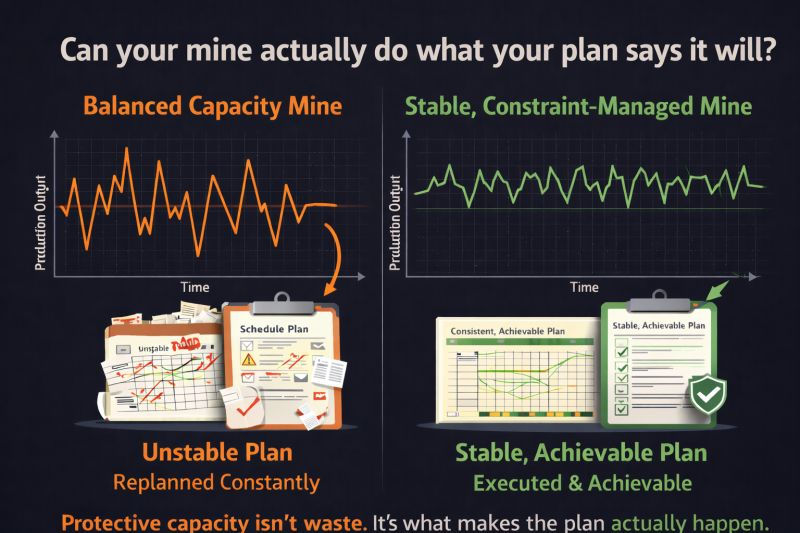
Most operations are set up with balanced capacity. Every station resourced for roughly the same average rate. Looks efficient on a spreadsheet. But in a system full of variability and dependent events, a balanced chain is the most fragile design possible. One hiccup anywhere ripples through the whole system. Your chain of 10s delivers 7. Sometimes less.
No amount of better modelling or tighter scheduling fixes that. The physics won’t let it.
That’s why the three questions matter so much.
If you can’t name the constraint, nobody knows what to protect. Every department chases its own KPIs and the bottleneck gets starved or blocked by people who believe they’re doing their jobs well.
If the bottleneck keeps shifting, you don’t have a scheduling problem. You have a system that’s being run reactively. No plan survives that.
And the third question is the one most mines never ask. It’s not “Is the plan good enough?” It’s “Is this mine actually capable of doing what this plan promises?” Because if every station is running flat out at the same target, there’s nothing left to absorb the inevitable disruptions. The plan looks solid at sign-off. By Wednesday it’s gone.
The mines that answer the third question properly end up with a deliberately unbalanced chain. The constraint runs at its rate. Everything else carries enough protective capacity to keep feeding it when things go sideways. That’s not a waste. That’s what makes the plan deliverable.
The difference is simple. One mine replans every month and wonders why. The other commits to a number and hits it, because the system was set up to make it possible.
If you can answer all three questions clearly, you’ve likely got something worth signing. If you can’t, you’re committing to a spreadsheet, not a production target.


Comments