
What changed
Across the 2024 to 2025 wave of Australian WHS reform — Queensland's Resources Safety and Health Legislation Amendment Act the leading example — five regulatory shifts have converged. Psychosocial hazards are now enforceable WHS obligations. Officers' due-diligence obligations are being interpreted as active verification, not passive review. Industrial manslaughter provisions now exist across most Australian WHS jurisdictions. Section 272A and equivalent provisions have narrowed what insurance can cover for many WHS penalties. Regulators increasingly examine systemic management factors during investigations.
The underlying hazards are not new. What has changed is the enforcement architecture sitting on top of them.
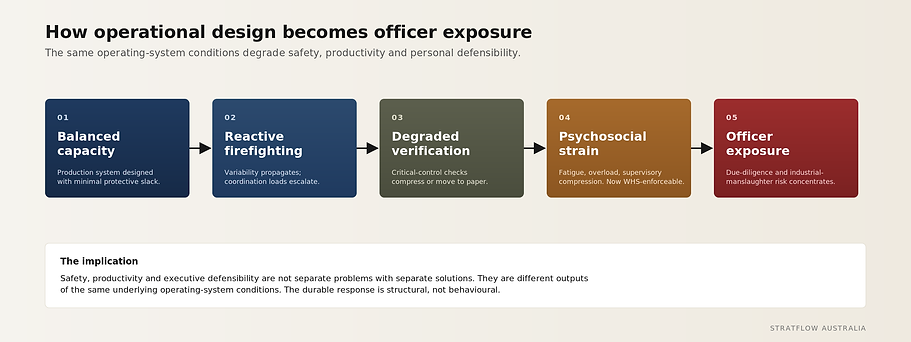
The same operating-system conditions that degrade critical-control execution also make modern due-diligence expectations harder to sustain in practice.
Safety, productivity and executive defensibility are different outputs of the same operating conditions.
How the cascade actually unfolds
Consider a balanced-capacity open-pit operation. A pit supervisor identifies, during the morning shift, that segregation bunds are at 40 per cent of the required tyre diameter where the standard specifies 50. The escalation protocol requires production to stop while corrective action is taken.
The haul road closes. Trucks reroute, adding twelve minutes per cycle. Haulage capacity drops thirty per cent. The crusher feed rate drops. The processing plant begins cycling. The ROM stockpile cannot bridge. The grader crew is redirected from road maintenance.
By the afternoon the operation is eight hundred tonnes behind target. The afternoon supervisor accelerates truck cycles and defers pre-start inspections on two loaders. Each pre-start inspection is a critical-control verification. The next morning the deferred road maintenance has produced surface deterioration and another near-miss.
Each decision in the cascade is a rational local response. The act of compliance itself destabilises the system. This is not a behavioural problem. No amount of additional discipline at the supervisor level will resolve it while the production-system architecture remains balanced.

The operating-system answer
If the durable response cannot come from asking already-stretched executives to do more, where does it come from? From changing the operating system itself so the capacity to be safe is created at source. Three structural components, each established in the operations-research literature.
1
Protective capacity around the constraint
Identify the one resource whose throughput determines whole-of-mine output. Design non-constraint resources to run with deliberate spare capacity. Disturbances are absorbed rather than propagated. The replanning load on the executive drops sharply within the first month.
2
Flow KPIs at the top of daily reporting
Constraint throughput, buffer health, disruption count, plan-change frequency. Protecting the constraint becomes the action the measurement system rewards rather than penalises. The end-of-month sprint becomes harder to produce.
3
A daily 30-minute cross-functional Flow Room
Operations, maintenance, planning, geology and safety in one room, asking one forward-looking question: what threatens constraint throughput in the next 12 to 48 hours, and what does each function commit to do about it. The minutes — named attendees, dated commitments — are exactly the operational control-room record the new regime is implicitly asking for. Produced as a routine output of how the mine runs.
This is not a productivity initiative with safety benefits. It is a safety intervention with productivity benefits.
A reversible first step
Few operators will, or should, commit to a wholesale implementation on the basis of a briefing paper. The first step that has worked across more than ninety implementation engagements is a structured 90-day diagnostic. The aim is not to add three months of work. It is to reorganise three months of existing work so the operator can see whether the structural pattern applies to their site.
With the leadership team, agree on the one resource that most reliably determines whether the mine meets its daily output target.
Define three to five Flow KPIs covering constraint throughput, buffer health, disruption count and plan-change frequency. Make them the first page of daily and weekly reporting for ninety days. The reporting cadence is run by the existing planning team.
For thirty minutes each morning, replace the existing departmental status meeting with a cross-functional Flow Room asking the one forward-looking question. The meeting is moved, not added. Minute it. Record attendance. Retain the minutes.
The diagnostic is structured and reversible at any point. It generates the evidence base for a full implementation decision while producing, from day one, the dated cross-functional records the new regime now requires for personal due diligence.